What Is an Arrow Puzzle Game?
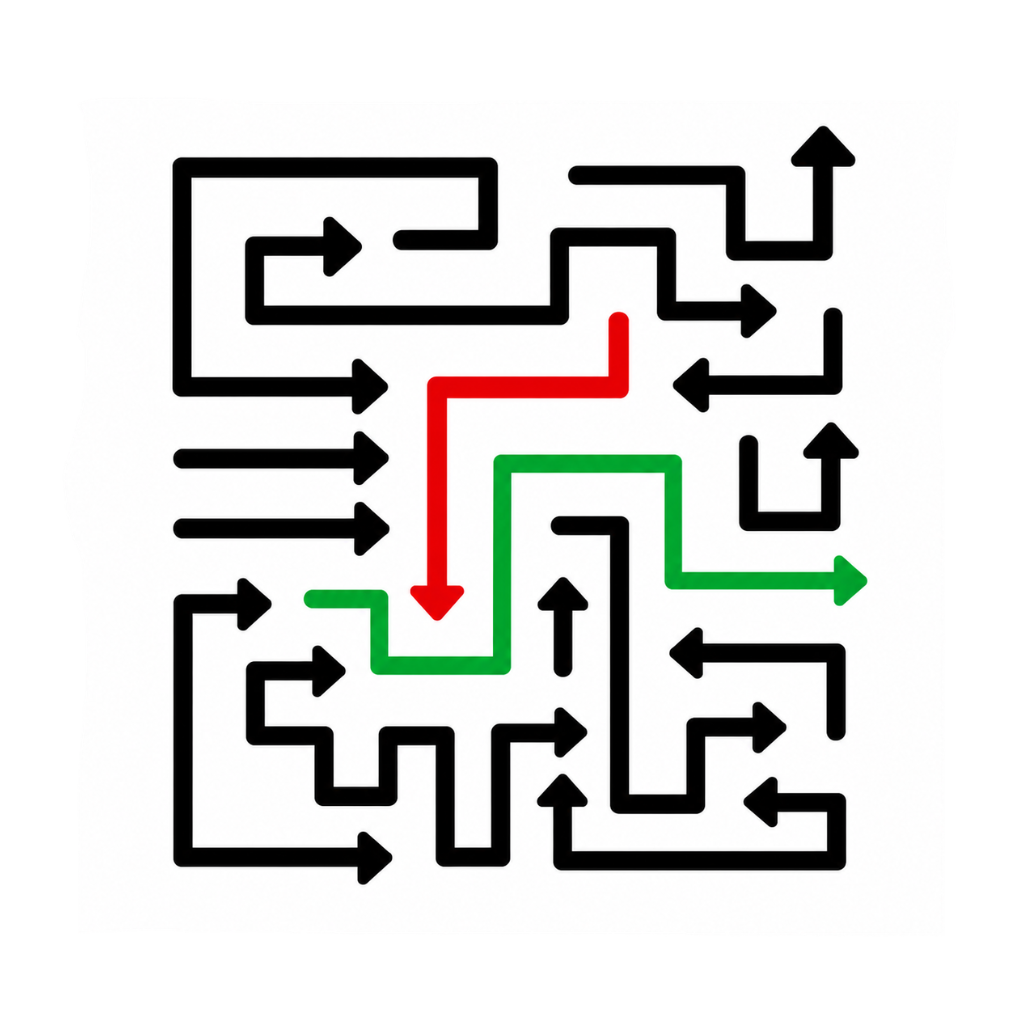
An arrow puzzle game — often called a "tap-away" puzzle or "arrow escape" game — is a logic puzzle built around a grid packed edge-to-edge with directional arrow tiles. Every arrow points one way: up, down, left, or right. Tap an arrow and, if nothing sits between it and the edge of the board in the direction it points, it slides off and disappears. The goal is to clear every arrow from the board.
The genre sits in a specific niche of casual puzzle games: no words, no numbers, no color-matching — just spatial reasoning and sequencing. That makes it language-independent and instantly readable, which is part of why arrow puzzle games have spread across app stores under a dozen slightly different names in the last few years.
What separates a good arrow puzzle game from a frustrating one is the same thing that separates a good sudoku from a bad one: a puzzle should always be solvable through logic, never through guessing. A well-built arrow puzzle board has exactly one thing standing between you and clearing it — figuring out the right order to tap.
How Arrow Puzzle (Tap-Away) Rules Actually Work
The rules are almost always the same across the genre, even when the visual theme or app name changes:
- Each tile is an arrow that only moves in the direction it points
- An arrow can be tapped and removed only if its entire path to the edge is empty
- Tapping a blocked arrow either does nothing or costs you a life/heart, depending on the game
- The level is won when every arrow has been cleared from the board
- Most versions add no hard timer — the challenge is purely about sequencing, not speed
Where games differ is in the failure state. Some are strict and end the level the moment you tap a blocked arrow. Others — like ArrowVolt — use a hearts system so one wrong tap costs a life instead of ending the run outright, which keeps early mistakes from feeling punishing while still rewarding careful play.
How to Solve Arrow Puzzles: Core Strategy
Arrow puzzles look like trial-and-error at first glance, but every solvable board can be cleared through a repeatable process rather than guessing:
- Scan for arrows that are already clear to the edge — tap those first, they cost you nothing
- Work outside-in: corner and edge arrows usually have fewer tiles blocking their path
- Before tapping, check what that arrow was blocking for other arrows — clearing the wrong tile first can wall off a cluster
- Plan two or three taps ahead instead of reacting one tile at a time
- If you get stuck, re-scan the whole board — the blocking arrow you need to clear is rarely the one you were just looking at
Read the full arrow puzzle strategy guide→Why Arrow Puzzle Games Are Popular Brain Games
Arrow puzzle and tap-away games occupy a specific spot in the broader brain-game category: they demand real spatial planning and sequencing, but without a timer forcing fast, error-prone decisions. That combination — genuine thinking, zero pressure — is why the genre has grown alongside sudoku, word search, and match-3 games as a go-to "quick brain break."
Compared to other logic puzzle genres, arrow puzzles have an unusually low barrier to entry: there is nothing to read, no numbers to compute, and the rule can be explained in one sentence. That makes them a common recommendation for casual brain-training sessions, commute-length play, or simply unwinding without the fatigue that timed or competitive games can cause.
Arrow Puzzle Naming & Variants Explained
If you have searched for this genre, you have probably seen it listed under several different names: "arrow puzzle," "tap away puzzle," "arrow escape," "arrow out," and "arrow maze" all describe close variations of the same core mechanic. Some add 3D perspective, colored arrow groups, or a timed challenge mode, but the underlying rule — tap an arrow, it slides off if the path is clear — stays constant across almost every app in the category.
Knowing this helps when you are searching for a puzzle to play: if a game is described with any of those terms, it is almost certainly the same genre with a different skin.
ArrowVolt: A Free Arrow Puzzle Game Built on These Rules
ArrowVolt applies everything above with a specific focus on fairness: every one of its 2,000+ levels is generated by reverse-construction and checked with a backtracking solver before it ships, so no board is ever a dead end. A hearts-and-hints economy replaces hard fail states, daily puzzle challenges keep short sessions interesting, and the whole game is offline-first — no account, no forced connection, progress saved locally on your device.
Play ArrowVolt free in your browser→This guide explains arrow puzzle and tap-away puzzle games: how the rules work, how to solve them, why they are a popular brain game, and how naming varies across apps (arrow puzzle, tap away, arrow escape, arrow out, arrow maze). ArrowVolt by PixelVolt is a free arrow puzzle game with 2,000+ solver-validated levels, playable offline in the browser and, later, on Android.