Strategy Guide
How to Play Arrow Puzzle Games
By Aadit Jha · Updated July 2026
The rule takes ten seconds to learn. Getting genuinely good at reading a board takes a real process — here it is, step by step.
The Basic Rule
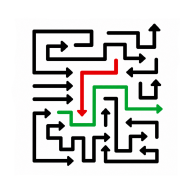
Every tile on the board is an arrow pointing one direction. Tap it, and it slides off the board in that direction — but only if every tile between it and the edge is already gone. If something is in the way, the tap fails (and usually costs you a life). Clear the entire board to win the level. That single rule is the whole game; everything below is about applying it well.
Five Core Tactics
1. Scan for free arrows first
Before tapping anything, look for arrows whose entire path to the edge is already empty. These cost you nothing and often open up the board for the harder decisions — always clear the obvious ones before touching anything ambiguous.
2. Work outside-in
Arrows near a corner or edge usually have fewer tiles between them and the boundary, so they tend to become clearable earlier than arrows buried in the middle. Treat the outer ring of the board as your first pass on every level.
3. Check what a tap is blocking before you make it
The most common beginner mistake is clearing an arrow that happened to be shielding a cluster of other arrows. Before you tap, ask what that tile was standing in front of — if removing it strands three other arrows behind a now-exposed wall of tiles, look for a different move first.
4. Plan two or three moves ahead
Reactive, one-tap-at-a-time play works on easy boards but breaks down on harder ones. Trace a short sequence — "if I clear this one, then this one opens up, then that one" — before committing to the first tap.
5. Re-scan the whole board when stuck
When no move seems available, resist the urge to keep staring at the same corner. The tile you need to clear next is very often on the opposite side of the board from where you were just looking — a fresh full scan finds it faster than tunnel vision.
Common Mistakes Beginners Make
- Tapping the first available arrow instead of checking what it blocks for others
- Clearing corner arrows without checking whether they wall off a whole edge behind them
- Ignoring one-tile gaps that look "already clear" until double-checked
- Panicking and tapping randomly under a timer instead of re-scanning calmly
- Assuming a stuck board is unsolvable rather than re-checking every arrow from scratch
Practicing Without a Timer vs. Challenge Mode
Learn the scanning process first without any time pressure — most arrow puzzle games, including ArrowVolt, default to an untimed mode for exactly this reason. Once reading the board quickly feels natural, a timed or daily-challenge mode turns the same skill into a genuine test, since you now have to apply the process fast instead of slowly working it out.
Related Guides
Frequently Asked Questions
Everything to know about arrow puzzle games. Can't find what you're looking for? Reach out to us.
How do I know which arrow is safe to tap?
An arrow is safe the moment its entire path to the edge of the board — in the direction it points — has no other tiles in the way. Trace the path visually before tapping rather than guessing.
What happens if I tap a blocked arrow?
It depends on the game. Some end the attempt immediately; others, like ArrowVolt, use a hearts system so a wrong tap costs one life instead of failing the level outright.
Is there a trick to always solving arrow puzzles?
The reliable method is not a single trick but a process: clear obviously-free arrows first, work from the edges inward, check what each tap is blocking before committing, and re-scan the full board whenever you get stuck.
Do arrow puzzle games get harder over time?
Yes, in well-designed games. ArrowVolt, for example, ramps difficulty across 2,000+ levels from simple warm-up boards to grids that require planning several moves ahead.
Does using a hint ruin the challenge?
Not really — a hint used after genuinely trying to solve a board still teaches you to recognize that pattern next time. Hints are best used to break a stall, not as the first move on a new level.
What is the best way to practice arrow puzzle games?
Play without a timer at first so you can practice reading the board fully before every tap. Once the scanning process feels automatic, timed or challenge modes become a fun test of the same skill under pressure.
Now try it on a real board.
2,000+ solver-validated levels in ArrowVolt, from easy warm-ups to boards that need every tactic above. Free, offline-first, no account required.
Free forever · No download · No account required